Various bodies and positions at the UN are elected by the General Assembly and the results of these elections are published on the General Assembly website. However they can often be difficult to find as they are not consolidated in one place (the “elections” tab on the General Assembly website only contains the results of elections to the Human Rights Council).
Here therefore we have consolidated all the election results from elections in the UN General Assembly during its 77th (2022-2023) session. It also includes the ECOSOC election that was held over from the 76th session and continued into the 77th. The list was up to date as of 8 June 2023 and will be updated three times a year: in June following the major round of elections to the UN Security Council and ECOSOC among others, in September on the conclusion of the General Assembly Session, and in late December/early January on the conclusion of the appointments by the new General Assembly Session for terms starting 1 January.
This list contains those positions that are elected by the General Assembly, and omits posts and committees (such as the Investments Committee) where the Secretary-General appoints a candidate and the General Assembly holds a confirmatory vote or those (such as the Joint Inspections Unit) where the President of the General Assembly appoints the candidate. Such appointments are covered on our senior appointments page if they meet our criteria for notability.
EDITORIAL NOTE: The information on this page includes inferences and at times draws on unverifiable intel. The compilation is a result of a rigorous process but the accuracy of information on this website cannot be guaranteed (indeed, the only way this information could be guaranteed is if the UN officially published it, in which case this website would no longer be required!). Please get in touch with us on hello@bluesmoke.blog if you spot any inaccuracies or have information that could be used to improve the content.
Human Rights Council
15 states were elected for a three year term starting 1 January 2024. States get to cast as many votes as there are vacancies by secret ballot. States needed the backing of 50% of those voting to be elected and to finish within the top n places where n is the number of vacancies. If insufficient candidates meet those criteria to fill the vacancies subsequent rounds of voting are held between the highest placed candidates until the vacancies are filled.
The full results were released here.
African States
Four candidates for four seats (closed slate)
- Malawi – 182 ELECTED
- Côte d’Ivoire – 181 ELECTED
- Ghana – 179 ELECTED
- Burundi – 168 ELECTED
- Nigeria – 3 (not formally running for election)
Asia-Pacific States
Four candidates for four seats (closed slate)
- Indonesia – 186 ELECTED
- Kuwait – 183 ELECTED
- Japan – 175 ELECTED
- China – 154 ELECTED
Eastern Europe States
Three candidates for two seats
- Bulgaria – 160 ELECTED
- Albania – 123 ELECTED
- Russian Federation – 83
Latin American and Caribbean States
Four candidates for three seats
- Cuba – 146 ELECTED
- Brazil – 144 ELECTED
- Dominican Republic – 137 ELECTED
- Peru – 108
Western Europe and other States
Two candidates for two seats (closed slate)
- Kingdom of the Netherlands – 169 ELECTED
- France – 153 ELECTED
International Court of Justice
Candidates need to receive an absolute majority (not just a majority of those voting) in both the General Assembly and the Security Council to be elected. Candidates from any nation may apply. Candidates usually serve a renewable nine year term of office but this was a special election to replace a judge who died in office and so the successful candidate will only see out the remainder of that judge’s term, which ends on 5 February 2027
The results were as follows:
General Assembly
- Leonardo Nemer Caldeira Brant (Brazil) 121 ELECTED
- Marcelo Gustavo Kohen (Argentina) 67
- Paulo Borba Casella (Brazil) 0
Security Council
- Leonardo Nemer Caldeira Brant (Brazil) 13 ELECTED
- Marcelo Gustavo Kohen (Argentina) 2
- Paulo Borba Casella (Brazil) 0
UN Appeals and Disputes Tribunal
Eight judges to the UN Appeals and Disputes Tribunal were elected on 15 November 2022:
- Four judges to the Appeals Tribunal for a seven year term starting 1 July 2023
- One judge to fill a vacancy on the Appeals Tribunal starting immediately and ending 30 June 2023
- One judge to the Dispute Tribunal in Geneva
- One judge to the Dispute Tribunal in Nairobi
- One “half time” judge who will serve for six months at a time rotating between the three dispute tribunals in Geneva, Nairobi and New York
States get to cast as many votes as there are vacancies by secret ballot. Candidates needed the backing of 50% of those voting to be elected and to finish within the top n places where n is the number of vacancies. If insufficient candidates meet those criteria to fill the vacancies subsequent rounds of voting are held between the highest placed candidates until the vacancies are filled. Candidates must be recommended by the Internal Justice Council but the Internal Justice Council recommends more candidates than there are vacancies, so the elections are competitive.
The full results are published here.
Appeals Tribunal seven-year term
Eight candidates for four seats
Round
1
- Nassib Ziadé (Lebanon/Chile) 108 ELECTED
- Abdelmohsen Ahmed Sheha (Egypt) 101 ELECTED
- Katharine Savage (South Africa) 100 ELECTED
- Thomas Pastor (Germany) 93
- Leslie Formine Forbang (Cameroon) 84
- Graciela Dixon Caton (Panama)83
- Vineet Kothari (India) 80
- Isabel Olmos (Spain) 78
Round
2
- Leslie Formine Forbang (Cameroon) 99 ELECTED
- Thomas Pastor (Germany) 89
Appeals Tribunal remainder of current term
Two candidates for one seat
- Gao Xiaoli (China) 109 ELECTED
- Jacqueline Cornelius (Barbados) 79
Dispute Tribunal Geneva
Three candidates for one seat
- Xiangzhuang Sun (China) 99 ELECTED
- Mira Mihaylova Raycheva-Shekerdzhieva (Bulgaria) 75
- Lucija Miše (Croatia) 15
Dispute Tribunal Nairobi
Four candidates for one seat
Round
1
- Sean Daniel Wallace (United States) 75
- Deepthi Amaratunga (Sri Lanka) 51
- Vineet Kothari (India) 35
- Roberto da Silva Fragale Filho (Brazil) 29
Round
2
- Sean Daniel Wallace (United States) 96 ELECTED
- Deepthi Amaratunga (Sri Lanka) 84
Dispute Tribunal Half-Time Judge
Two candidates for one seat
- Solomon Waktolla (Ethiopia) 97 ELECTED
- Joanne Harrison (Australia) 90
Committee for Programme and Coordination
Seven states were elected to the Committee for Programme and Coordination (the main subsidiary organ of the Economic and Social Council) on 15 November 2022. These posts are nominated by the UN Economic and Social Council (ECOSOC) and then elected by the General Assembly. As ECOSOC nominated, without a vote, seven candidates for the seven vacancies, the General Assembly confirmed their choice, also without a vote. They will serve a three year term starting 1 January 2023.
They are:
Africa Group
- Liberia
- Morocco
- Tunisia
Asia-Pacific Group
- China
- Philippines
- Republic of Korea
Latin American and Caribbean Group
- Argentina
Advisory Committee on Administrative and Budgetary Questions (ACABQ)
Eight states’ candidates were elected to the ACABQ (a powerful subcommittee of the General Assembly’s fifth (budgetary) committee) on 15 November 2022. These posts are nominated by the Fifth Committee and then elected by the General Assembly. As the Fifth Committee nominated, without a vote, eight candidates for the eight vacancies, the General Assembly confirmed their choice, also without a vote.
They are:
For a three-year term beginning on 1 January 2023
- Udo Fenchel (Germany)
- Olivio Fermín (Dominican Republic)
- Carlo Jacobucci (Italy)
- Ji Haojun (China)
- Ji-sun Jun (Republic of Korea)
- Matsuda Yukiko (Japan).
For a term beginning on 1 January 2023 and ending on 31 December 2023
- Stephani Scheer (United States)
For a term beginning on 15 November 2022 and ending on 31 December 2023
- Surendra Kumar Adhana (India).
Committee on Contributions
Six states’ candidates were elected to the Committee on contributions (a subcommittee of the General Assembly’s fifth (budgetary) committee that considers amounts states should pay to the UN) on 15 November 2022 for a three-year term beginning on 1 January 2023. These posts are nominated by the Fifth Committee and then elected by the General Assembly. As the Fifth Committee nominated, without a vote, six candidates for the six vacancies, the General Assembly confirmed their choice, also without a vote.
They are:
- Cheikh Tidiane Dème (Senegal)
- Gordon Eckersley (Australia)
- Helena Concepción Felip Salazar (Paraguay)
- Bernardo Greiver del Hoyo (Uruguay)
- Marcel Jullier (Switzerland)
- Joseph Masila (Kenya)
International Civil Service Commission
Five states’ candidates were elected to the International Civil Service Commission (a body that advises the executive heads of UN agencies on staff conditions) on 15 November 2022 for a four year term beginning on 1 January 2023. These posts are nominated by the Fifth Committee and then elected by the General Assembly. As the Fifth Committee nominated, without a vote, five candidates for the five vacancies, the General Assembly confirmed their choice, also without a vote.
They are:
- Andrew Gbebay Bangali (Sierra Leone)
- Xavier Bellmont Roldán (Spain)
- Ali Kurer (Libya)
- João Vargas (Brazil)
- Boguslaw Winid (Poland)
The chair was also elected. There were two candidates for Chair considered by the fifth committee and so a vote was held the result of which was as follows:
- Larbi Djacta (Algeria) 121
- El Hassane Zahid (Morocco) 64
On that basis the fifth committee decided to elect Larbi Djacta to serve as chair for a four year term beginning on 1 January 2023 and this recommendation was accepted by the General Assembly without a vote.
Independent Audit Advisory Committee
Two states’ candidates were elected to the Independent Audit Advisory Committee (a body that advises the General Assembly on its oversight responsibilities) on 15 November 2022, and a third was elected on 21 November 2022 for a three year term beginning on 1 January 2023. These posts are nominated by the Fifth Committee and then elected by the General Assembly. As the Fifth Committee nominated, without a vote, two candidates for the two vacancies on the first occasion and one candidate for one vacancy on the second, the General Assembly confirmed their choices, also without a vote.
They are:
- Anton V. Kosyanenko (Russian Federation)
- Suresh Raj Sharma (Nepal)
- Dorothy Bradley (Belize)
United Nations Staff Pension Committee
One state’s candidate was elected to the United Nations Staff Pension Committee on 15 November 2022 to see out the remainder of a term that lasts until 31 December 2024. These posts are nominated by the Fifth Committee and then elected by the General Assembly. As the Fifth Committee nominated, without a vote, one candidate for the vacancy, the General Assembly confirmed their choice, also without a vote.
They are:
- Yamada Jun (Japan)
Peacebuilding Commission
The Peacebuilding Commission is a commission of member states established in 2005. The principal configuration it takes is a standing Organisational Committee established as follows:
- Seven members elected by the General Assembly
- Seven members selected by the Security Council
- Seven members elected by the Economic and Social Council
- Five top providers of military personnel and civilian police to United Nations missions selected by and from among the ten top providers based on the average annual contributions in the previous three calendar years for which statistical data are available
- Five top providers of assessed contributions to United Nations budgets and of voluntary contributions to the United Nations funds, programmes and agencies, including a standing peacebuilding fund selected by and from among the ten top providers based on the average monthly contributions in the previous three calendar years for which statistical data are available
Each is elected for a two year renewable term. Five General Assembly members were elected on 20 December to fill five vacancies starting 1 January 2023. The following candidates were elected without a vote:
- Egypt
- Kenya
- Qatar
- Saint Vincent and the Grenadines
- South Africa
Economic and Social Council (ECOSOC) 76th session
The Economic and Social Council is a core body of the UN system. The Council consists of 54 Member States, which are elected yearly by the General Assembly for overlapping three-year terms. States needed the backing of two thirds of those voting to be elected and to finish within the top n places where n is the number of vacancies. If insufficient candidates meet those criteria to fill the vacancies subsequent rounds of voting are held between the highest placed candidates until the vacancies are filled.
Elections were held on June 10 2022 for terms beginning 1 January 2023 for eighteen vacancies. The full results are not published but the winners and the number of votes they received are available here. Given those vote totals it appears unlikely there were other official candidates running, as they would have had to have been very unsuccessful to have had such little impact on the other vote totals. We therefore believe that the Eastern European Group was the only competitive race.
Results:
Africa Group
Presumably four candidates for four vacancies
- Botswana 190 ELECTED
- Cabo Verde 190 ELECTED
- Cameroon 189 ELECTED
- Equatorial Guinea 186 ELECTED
- Others: unknown
Asia Group
Presumably four candidates for four vacancies
- Qatar 186 ELECTED
- Lao People’s Democratic Republic 181 ELECTED
- Republic of Korea 178 ELECTED
- China 172 ELECTED
- Others: unknown
Latin American and Caribbean Group
Presumably three candidates for three vacancies
- Brazil 183 ELECTED
- Costa Rica 182 ELECTED
- Colombia 180 ELECTED
- Others: unknown
Western Europe and Other Group
Presumably four candidates for four vacancies
- Greece 176 ELECTED
- Sweden 175 ELECTED
- Denmark 174 ELECTED
- New Zealand 174 ELECTED
- Others: unknown
Eastern Europe Group
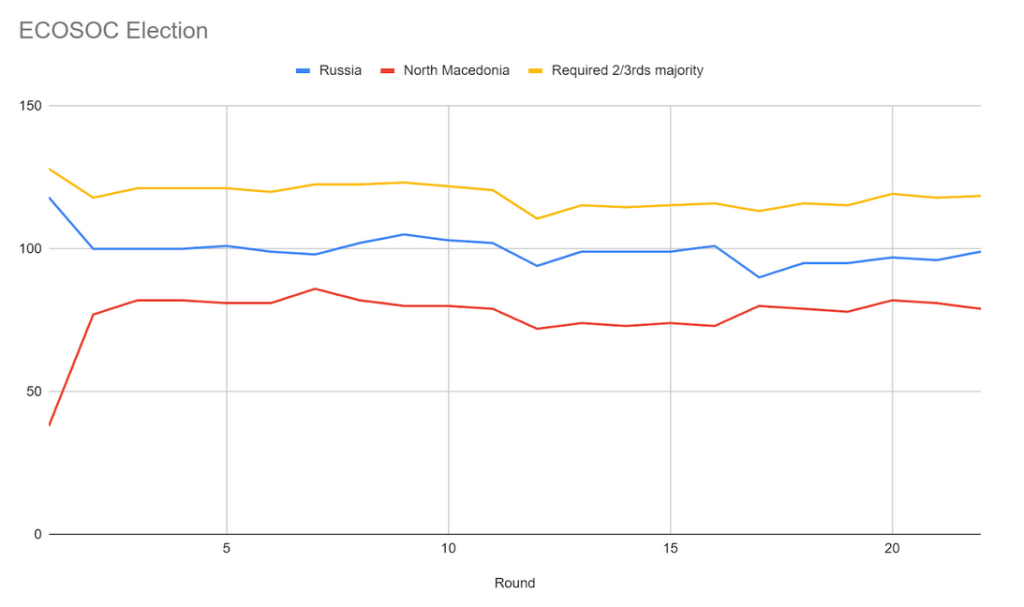
Four candidates for three vacancies
Round 1
No official result available, this result pieced together from the official part-result, and credible third party reporting.
- Slovenia 176 ELECTED
- Slovakia 173 ELECTED
- Russia 118
- North Macedonia 38
Round 2
No official result available, this result was found via credible third party reporting.
- Russia 100
- North Macedonia 77
Round 3
No official result available, this result was found via credible third party reporting.
- Russia 100
- North Macedonia 82
Round 4
No official result available, this result was found via credible third party reporting.
- Russia 100
- North Macedonia 82
Round 5
No official result available, this result was found via credible third party reporting.
- Russia 101
- North Macedonia 81
Round 6
No official result available, this result was found via credible third party reporting.
- Russia 99
- North Macedonia 81
With no result having been possible elections were postponed until June 16.
Round 7
No official result available, this result was found via credible third party reporting.
- Russia 98
- North Macedonia 86
Round 8
No official result available, this result was found via credible third party reporting.
- Russia 102
- North Macedonia 82
Round 9
No official result available, this result was found via credible third party reporting.
- Russia 105
- North Macedonia 80
Round 10
No official result available, this result was found via credible third party reporting.
- Russia 103
- North Macedonia 80
Round 11
No official result available, this result was found via credible third party reporting.
- Russia 102
- North Macedonia 79
With no result having been possible elections were postponed until July 11
Round 12
Official results are available for rounds 12-16.
- Russia 94
- North Macedonia 72
Round 13
- Russia 99
- North Macedonia 74
Round 14
- Russia 99
- North Macedonia 73
Round 15
- Russia 99
- North Macedonia 74
Round 16
- Russia 101
- North Macedonia 73
Round 17
Official results are available for rounds 17-19 although they mislabel the rounds as 7-9 having seemingly ignored the rounds of voting on June 16 and July 11.
- Russia 90
- North Macedonia 80
Round 18
- Russia 95
- North Macedonia 79
Round 19
- Russia 95
- North Macedonia 78
With no result possible elections were postponed until a later date in the 77th session of the General Assembly. Voting ultimately recommended on 20 December 2022.
Round 20
Official results are available for rounds 20-22 although they mislabel the rounds as 10-12 having seemingly ignored the rounds of voting on June 16 and July 11.
- Russia 97
- North Macedonia 82
Round 21
- Russia 96
- North Macedonia 81
Round 22
- Russia 99
- North Macedonia 79
With no result possible elections were postponed until a later date to be confirmed. In the meantime there is a vacant seat at ECOSOC, and has been since 1 January 2023.
Round 23
While this is not recorded in any of the media statements of the General Assembly, viewers of the UN Web TV live stream will have noticed that on June 8 2023 another round of elections for this seat were held
- Russia 102
- North Macedonia 82
No result having been possible, further voting was postponed to an as yet to be announced date.
Here are the rounds of elections 1-22 in the form of a graph:
President of the General Assembly
The UN General Assembly elects a new President annually for the next session. Convention dictates that the role is rotated between the UN regions and on this occasion it was the turn of the Group of Latin American and Caribbean regions. As occurs about half the time, on this occasion the post was uncontested and so Dennis Francis of Trinidad and Tobago was elected by acclamation on 1 June 2023.
The General Assembly also elects 21 Vice Presidents. These consist of the five permanent representatives of the five permanent members of the UN Security Council (the US, UK, France, Russia and China) and 16 Vice Presidents elected by the General Assembly. The following Vice Presidents were elected unopposed
- Bolivia
- Congo
- Estonia
- Gambia
- Iceland
- Iran
- Malaysia
- Morocco
- Netherlands
- Senegal
- Singapore
- Sri Lanka
- Suriname
- Uganda
- Uzbekistan
- Zambia
However, while these elections were unopposed for want of any alternative candidates both the United States and Israel did speak at the meeting to place on record their objection to Iran’s elections.
Following the meeting the six main committees of the General Assembly met, and elected by acclamation the following roles:
The First Committee (Disarmament and International Security) elected Rytis Paulauskas (Lithuania) as Chair; Yaseen Lagardien (South Africa), Matías Andrés Eustathiou de los Santos (Uruguay) and Christine Nam (New Zealand) as Vice-Chairs; and Heidar Ali Balouji (Iran) as Rapporteur.
The Second Committee (Economic and Financial) elected Carlos Amorín (Uruguay) as Chair; Jeswuni Abudu-Birresborn (Ghana), Nichamon May Hsieh (Thailand) and Diego Antonino Cimino (Italy) as Vice-Chairs; and Ivaylo Gatev (Bulgaria) as Rapporteur.
The Third Committee (Social, Humanitarian and Cultural) elected Alexander Marschik (Austria) as Chair; Nelly Banaken Elel (Cameroon), Mosammat Shahanara Monica (Bangladesh) and Tomáš Grünwald (Slovakia) as Vice-Chairs; and Robert Alexander Poveda Brito (Venezuela) as Rapporteur.
The Fourth Committee (Special Political and Decolonization) elected Mathu Joyini (South Africa) as Chair; Patryk Jakub Woszczek (Poland), Joaquín Alberto Pérez Ayestarán (Venezuela) and Sara Rendtorff-Smith (Denmark) as Vice-Chairs; and Mariska Dwianti Dhanutirto (Indonesia) as Rapporteur.
The Fifth Committee (Administrative and Budgetary) elected Osama Mahmoud Abdelkhalek Mahmoud (Egypt) as Chair; Mohammed Khalifa H Alnasr (Qatar), Amalia Irina Pufulescu (Romania) and Kimberly K. Louis (Saint Lucia) as Vice-Chairs; and María Reyes Fernández (Spain) as Rapporteur.
The Sixth Committee (Legal) elected Suriya Chindawongse (Thailand) as Chair; Jhon Guerra Sansonetti (Venezuela), Alis Lungu (Romania) and Enrico Milano (Italy) as Vice-Chairs; and Moussa Mohamed Moussa (Djibouti) as Rapporteur.
UN Security Council
On 6 June 2023 5 states were elected for a two year term starting 1 January 2023. States require two thirds of those member states present and voting to be elected, and as 192 states participated in this election that means that 128 votes are needed to win.
The UN only announced the winners in the official press release, not the number of votes obtained, but this information can be found by watching the UN Web TV broadcast.
The following candidates were elected unopposed
- Guyana with 191 votes
- Sierra Leone with 188 votes
- Algeria with 184 votes
- Republic of Korea with 180 votes
The only contested election was in the Eastern European Group and was decided in one round:
- Slovenia 153 votes ELECTED
- Belarus 38 votes
Economic and Social Council (ECOSOC) 77th session
Elections were held on June 8 2023 for terms beginning 1 January 2024 for nineteen vacancies.
The UN only announced the winners in the official press release, not the number of votes obtained, but this information can be found by watching the UN Web TV broadcast.
By election to fill the seat vacated by Greece
This was a by election to fill the remainder of this term from 1 January 2024 and end on 31 December 2025. The by election was restricted to candidates from the Western Europe and Other Group.
- Türkiye 186 votes ELECTED
- Andorra 1 vote
African Group
Five vacancies
- Nigeria 191 votes ELECTED
- Senegal 190 votes ELECTED
- Zambia 190 votes ELECTED
- Kenya 189 votes ELECTED
- Mauritania 189 votes ELECTED
Asia Group
Three vacancies (124 votes required to win)
- Nepal 145 votes ELECTED
- Pakistan 129 votes ELECTED
- Japan 127 votes ELECTED
- Tajikistan 97 votes
- Iraq 50 votes
Eastern European Group
One vacancy
- Poland 177 votes ELECTED
Latin American and Caribbean Group
Four vacancies
- Suriname 189 votes ELECTED
- Haiti 184 votes ELECTED
- Paraguay 184 votes ELECTED
- Uruguay 184 votes ELECTED
Western European and Other Group
Five vacancies
- Spain 176 votes ELECTED
- Liechtenstein 174 votes ELECTED
- Germany 170 votes ELECTED
- France 163 votes ELECTED
- UK 162 votes ELECTED
- San Marino 2 votes
 Blue Smoke